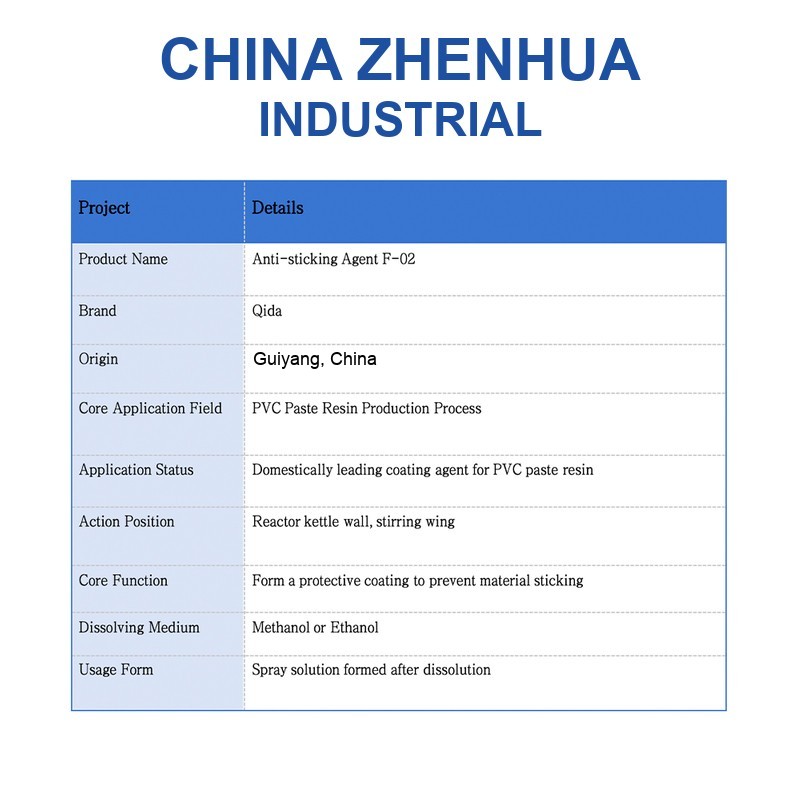
Anti-Sticking Agents
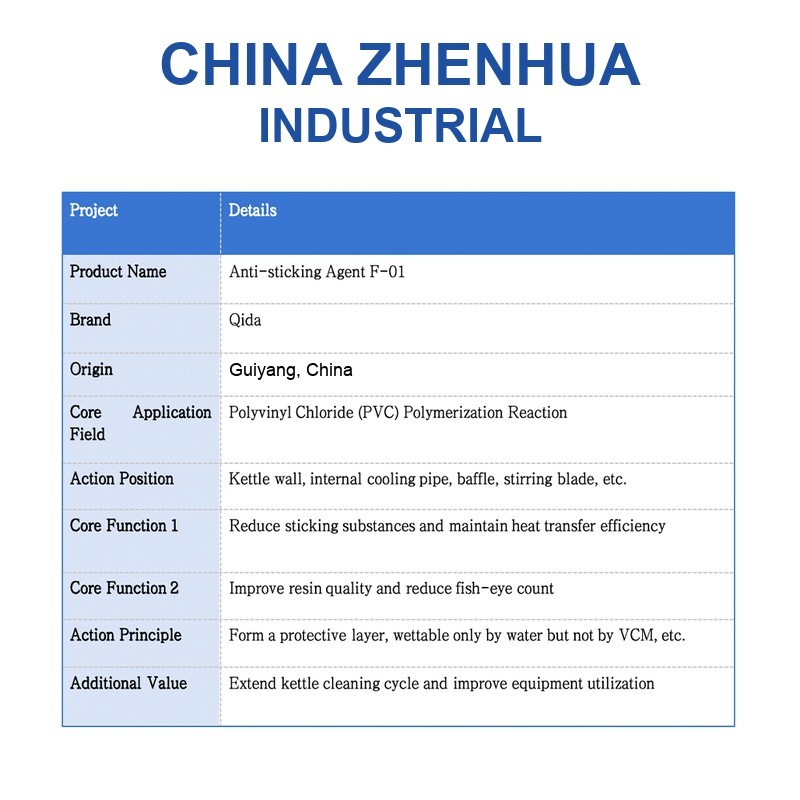
Anti-Sticking Agent F-01 for PVC Polymerization Extend Cleaning Cycle
Product details
Ⅰ.qualification :
Appearance: Light yellow liquid
Density (20℃, g/cm3):1.02
pH: 12-13.5
Active ingredient content%: ≥5.5
Light stability: good
Precipitated flocs: none
Ⅱ.apply :
During PVC polymerization, adherent deposits frequently form on reactor walls, inner cooling tubes, baffles, and
agitator blades. These deposits not only reduce heat transfer coefficients and diminish the reactor's thermal efficiency,
hindering effective heat dissipation, but also degrade resin properties by incorporating impurities that impair particle
characteristics, thermal stability, and monomer release performance, while increasing fish-eye defects. To address this, PVC
manufacturers apply a thin protective coating to the stainless steel inner walls of reactors. This coating is water-wettable but
resistant to contact with VCM or viscous VCM-PVC droplets, effectively preventing material adhesion. Consequently, it
extends cleaning intervals, enhances equipment utilization, and improves resin quality.
Ⅲ.The specific usage is as follows:
1. Before use, thoroughly clean the reactor by removing resin residues from the walls. Secure the manhole cover and
open the bottom discharge valve.
2. Raise the jacket temperature of the reactor to 75-80℃;
3. Drain all condensate from the steam pipeline;
4. Add a measured amount of anti-stick agent to the spray tank;
5. Open the steam valve and spray valve to atomize the anti-stick agent evenly onto the inner surface of the reactor,
with the spraying process taking approximately 30-60 seconds. Unatomized water vapor condensate and a small amount of
anti-stick agent are discharged through the bottom valve.
Ⅳ.Reference usage
Appearance: Light yellow liquid
Density (20℃, g/cm3):1.02
pH: 12-13.5
Active ingredient content%: ≥5.5
Light stability: good
Precipitated flocs: none
Ⅱ.apply :
During PVC polymerization, adherent deposits frequently form on reactor walls, inner cooling tubes, baffles, and
agitator blades. These deposits not only reduce heat transfer coefficients and diminish the reactor's thermal efficiency,
hindering effective heat dissipation, but also degrade resin properties by incorporating impurities that impair particle
characteristics, thermal stability, and monomer release performance, while increasing fish-eye defects. To address this, PVC
manufacturers apply a thin protective coating to the stainless steel inner walls of reactors. This coating is water-wettable but
resistant to contact with VCM or viscous VCM-PVC droplets, effectively preventing material adhesion. Consequently, it
extends cleaning intervals, enhances equipment utilization, and improves resin quality.
Ⅲ.The specific usage is as follows:
1. Before use, thoroughly clean the reactor by removing resin residues from the walls. Secure the manhole cover and
open the bottom discharge valve.
2. Raise the jacket temperature of the reactor to 75-80℃;
3. Drain all condensate from the steam pipeline;
4. Add a measured amount of anti-stick agent to the spray tank;
5. Open the steam valve and spray valve to atomize the anti-stick agent evenly onto the inner surface of the reactor,
with the spraying process taking approximately 30-60 seconds. Unatomized water vapor condensate and a small amount of
anti-stick agent are discharged through the bottom valve.
Ⅳ.Reference usage
| pot type | Amount (kg) |
| 45m 3 | 2.5 |
| 70m 3 | 6-8 |
| 105m 3 | 10-12 |
| 143m 3 | 7.5-10 |
Ⅴ.Storage and shelf life
It should be stored in a dry, ventilated and low temperature warehouse.
Ⅵ.pack
Ⅵ.pack
The product is packaged in 200kg plastic drums and 1000kg drums.